
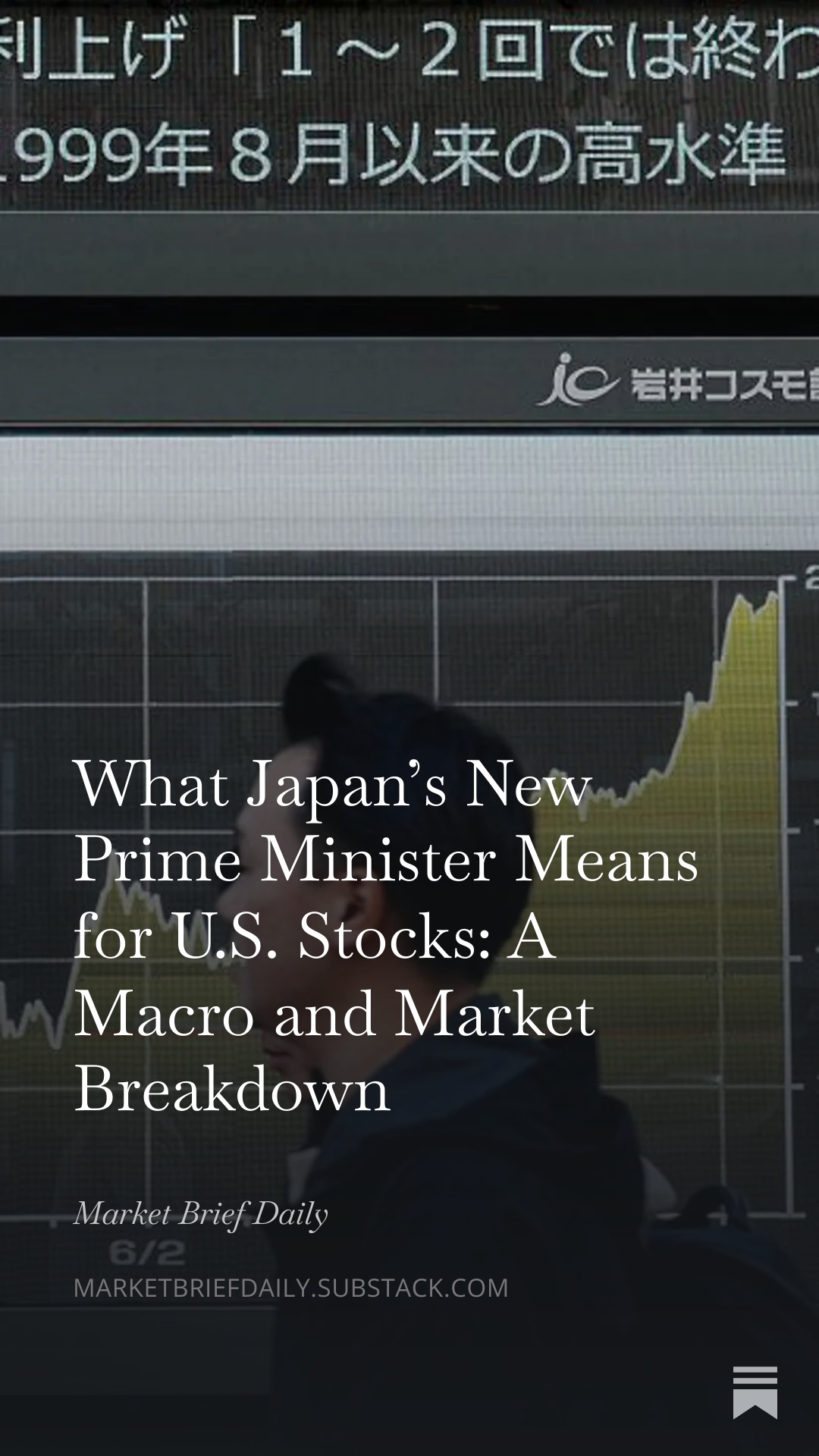
The recent Japanese election has financial markets paying attention, but for very different reasons depending on the audience. Mainstream coverage focuses on diplomacy and headline optimism. Financial markets and macro investors are focused on interest rates, capital flows, currency mechanics, and the consequences for global asset prices.
For U.S. investors, what happens in Japan matters because of the scale of capital involved and the structural linkages between Japanese investment flows and U.S. financial markets.
Japan Election Result and Policy Orientation
Japan elected a new prime minister whose party secured a two-thirds majority in the Diet. This supermajority enables policy implementation without compromise. The government has signaled fiscal stimulus, tax cuts, defence spending, and broader pro-growth initiatives.
Interest Rates in Japan and the End of Zero
Japanese 10-year yields have risen above 2.3%, the highest level in roughly 27 years. While low globally, this is a structural break for Japan after decades of near-zero rates.
The Carry Trade and Its Impact on U.S. Markets
- Borrow yen at near-zero rates
- Convert to USD
- Buy U.S. bonds, equities, and real estate
- Capture the yield differential
Rising Japanese rates compress this spread and reduce incentives to hold U.S. risk assets. Unwinds increase selling pressure in U.S. stocks and bonds.
Japanese Foreign Reserves and Policy Funding
Japan holds roughly $1.4 trillion in foreign reserves. Fiscal stimulus could require selling U.S. Treasuries, raising U.S. yields and tightening financial conditions.
Market Transmission Mechanisms
- FX: Yen strength signals repatriation and reduces U.S. equity support.
- Bonds: Treasury selling raises yields and compresses equity multiples.
- Equities: Carry unwind reduces foreign bid for U.S. risk assets.
- Credit: Higher yields widen spreads and hit leverage.
Framework for Investors
- Track Japanese capital flows into U.S. assets
- Monitor USDJPY regime changes
- Watch yield spreads (JGB vs Treasuries)
- Assess rate sensitivity in equity exposure
- Consider real assets as hedges
Conclusion
Structural shifts in Japanese policy and rates have global consequences. Understanding capital flow mechanics offers a durable framework beyond price-only analysis.
For regular macro updates and portfolio tracking, follow www.themarketbriefdaily.com
Enjoyed this? Get the next brief in your inbox.